AI avatar · Hospice
Eleanor Griggs
Patient, receiving a diagnosis
“I’m here for my results, but I’m terrified of what you’re going to tell me. Is it as bad as I think?”
Deliver a serious diagnosis (SPIKES)

Students talk out loud with an AI avatar that plays the patient. They practice hard moments, like giving bad news, before they meet real patients. Each try gets a score on your checklist.
AI avatar · HospiceEleanor Griggs
Patient, receiving a diagnosis
“I’m here for my results, but I’m terrified of what you’re going to tell me. Is it as bad as I think?”
Deliver a serious diagnosis (SPIKES)
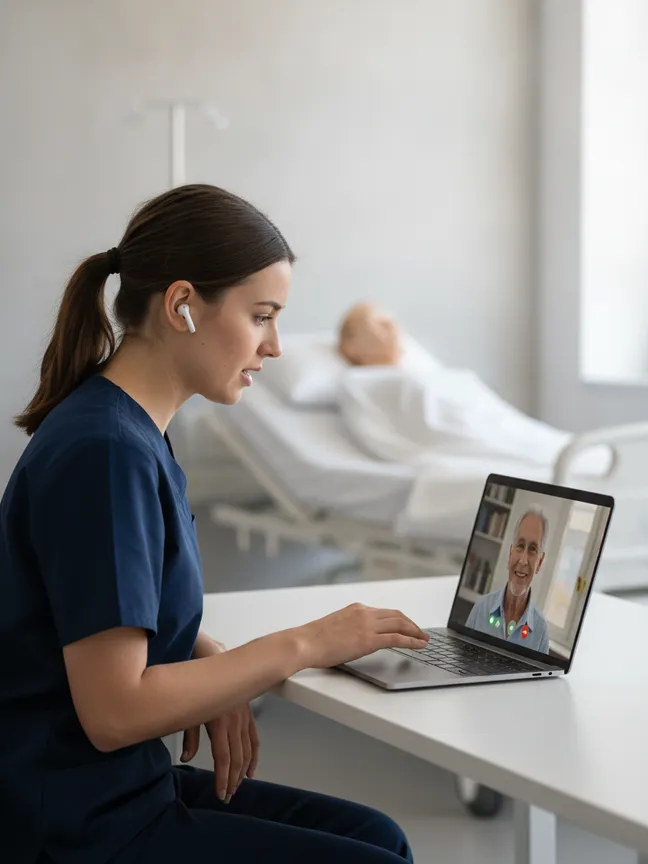
They have said the hard words out loud before, so a real patient isn't their first try.
Each student meets the same patient in the same mood, scored against the same checklist.
Scores arrive seconds after each try. Faculty review the transcripts that need a second look.
A student under your cutoff runs the case again until the score clears it.
Trainio gives nursing, medical, and allied health programs AI roleplay for the talks students fear most. A student breaks bad news or calms a combative patient with a realistic AI avatar. The patient reacts to every word. Each try is scored against your faculty's checklist. Live standardized patient time goes to the cases that need a person.
Even a great actor adapts to a student who's struggling. The AI patient plays the case the same way for each one.
A student who froze in today's session can run the same case again tonight, from home.
Every try is saved with its score and transcript. Faculty read the ones that need a second look.
Cases for breaking bad news, combative patients, trauma disclosure, and error disclosure are live today. Try one yourself: every card on this page opens a live preview in your browser.

A patient asks what the biopsy showed. Students practice the SPIKES steps out loud before a real family is waiting.
Explore scenarios →
A patient is shouting about the wait and won't sit down. Students practice staying calm and setting a limit without a lecture.
Explore scenarios →
A guarded patient gives one-word answers. Students practice the questions that earn an honest history.
Explore scenarios →Ready-made roleplay cases for healthcare students: bad news, anger, a trauma disclosure, a medication error. Students practice each one with a realistic AI avatar.

Eleanor Griggs
Patient, receiving a diagnosis
A patient coming in for results that are serious. Learner must walk the SPIKES arc — set up the conversation, check what she already suspects, deliver the news plainly, hold the emotion, and agree on next steps — without hiding behind jargon.
Skills you'll train

Devon Carter
Residential treatment client
A client turning verbally hostile and physically agitated after feeling disrespected. The AI intensifies if challenged, calms with acknowledgment and space. Learner must defuse, set a calm limit, and keep everyone safe.
Skills you'll train

Elena Vasquez
Counseling client
A client who unexpectedly discloses trauma and becomes distressed. Learner must respond with trauma-informed calm, avoid probing for detail, and help ground the client safely.
Skills you'll train

Colleen Marsh
Daughter and health-care proxy of a resident
A resident's daughter and health-care proxy arrives after hearing from a roommate that something happened: her father's morning anticoagulant was given twice at shift change and he is being monitored. She swings between fear and anger and asks whether it was someone's fault. Learner must disclose what happened early and in plain words, acknowledge it and apologize without blaming a colleague, explain what is being done now and what the review will look at, and agree how she will hear next steps.
Skills you'll train

Maya Sullivan
New intake client
A new client who is suspicious, gives clipped answers, and doesn't want to be there. Learner must build enough trust to gather history, explain confidentiality, and lower defensiveness.
Skills you'll train

Amara Okafor
Outgoing resident assistant
At shift change, outgoing caregiver Amara Okafor has noticed that Mr. Bell has eaten little, seems weaker, and needed more cueing than usual, but the details are scattered across a busy shift. She initially minimizes the pattern as “probably just tired” when pressed. The learner must give a concise, trend-based handoff, distinguish observation from interpretation, name what has and has not been done, and confirm the next staff member’s follow-up responsibility.
Skills you'll train
Need a conversation that isn't here? Make it from your protocol: build your own scenario
Pick a hard conversation, make it look and sound like your patients, send it to your staff, and see who's ready. No trainer to book, no classroom to fill.
Start with one of 1,000+ ready-made scenarios, or type what happened on your floor last week. In a minute or two you get a patient to talk to and a checklist of what good looks like.
Choose how hard the patient is, pick their face and voice, and set the rules the conversation has to follow. Then decide what a pass looks like for your team.
Assign it to the front desk, the night shift, or this month's new hires. Everyone gets a link and practices on their own time, on any shift.
Every practice is scored the same way, with a transcript. You see who's ready by person, team, and site, and you have something to show a surveyor.
Each try is scored against the checklist your faculty set, with the transcript behind every score. You see results by student and group. Practice doesn't replace your clinical skills exams or sign-off.
Attach your case write-up and checklist. The AI patient follows it. Your faculty read it, change what's wrong, and assign it.
A try takes three to ten minutes in a browser, from the library or at home. There's no room to book and no actor to schedule.
The studies on AI in nursing and medical education that a sim director will ask about, with links. Trainio adds practice around your program. It doesn't replace standardized patients or faculty. See how practice fits a nursing competency assessment program.
A 2014 study by the National Council of State Boards of Nursing found students did just as well with more simulation. It replaced up to half of their clinical hours, in person, with trained faculty and a debrief.
NCSBN simulation guidelinesA 2020 review in Medical Education looked at virtual patients for communication training. The programs that worked paired them with debriefing and feedback from people.
Lee et al., Medical Education, 2020A 2026 trial in JMIR Medical Education found 30 minutes with an AI virtual patient helped more than a reading module. Medical, nursing, and PA learners got better at serious-illness conversations.
Haut et al., JMIR Medical Education, 2026A 2026 study in the American Journal of Pharmaceutical Education added up one OSCE, the clinical skills exam with actors. Three stations took 250 staff hours and $12,121 in direct costs.
Barnes et al., AJPE, 2026Attach a case write-up from your own course and talk to the patient it makes, right here, before any demo.
Build your own scenarioLook for an AI patient that talks back. Students should speak out loud, and the patient should react to how they say it. Faculty should write the checklist and be able to read every transcript. Cases should follow your own curriculum. And practice should work outside the sim lab, so each student gets more than one try.
On Trainio: The AI patient gets more upset when brushed off. It calms down when a student slows down and explains.
On Trainio: Your faculty write the checklist. Every student is scored against it the same way.
On Trainio: Attach a case write-up or checklist. The AI patient follows it.
On Trainio: A score and transcript for every practice, by student and group.
AI roleplay for nursing and medical schools is practice with a realistic AI avatar that plays the patient. Students talk out loud, and the patient answers what they say. Each try is scored against the checklist your faculty set, with a transcript faculty can read. It fits between lectures, sim lab days, and clinicals.
It works for any program where students learn to talk with patients. Nursing and NP students practice bad news, refusals, and handoffs. Medical and PA students practice taking a history and giving a hard diagnosis before their clinical skills exam. Dental, counseling, and allied health programs can use the same cases.
Since USMLE Step 2 CS ended in 2021, medical schools assess clinical skills on their own. Students can practice the talking parts, like taking a history or giving a hard diagnosis, with a realistic AI avatar before your clinical skills exam. Faculty set the checklist. Graded exams and physical exams stay with your standardized patient program.
Nurse educators assign a case before a sim lab day or a clinical rotation. Students practice out loud with a realistic AI avatar as many times as they need. Faculty read the scores and transcripts, then bring the weak spots to the debrief. Among digital tools for nursing faculty, it does one job: the patient conversation.
Every try is scored against a checklist your faculty write, the way a rubric works. Each item is a behavior, like naming the patient's fear before giving the plan. Every student is scored the same way, and faculty can read every transcript. Use scores for practice and coaching. Before a graded exam, check them like any new rubric.
Faculty can build their own roleplay cases from a case write-up, checklist, or syllabus page. Describe the moment and attach the document as a PDF, Word file, or slides. You get a patient to talk to in minutes. Faculty read it, change what's wrong, and assign it. Use made-up patients, never real patient details.
The AI patient stays in its role for the whole conversation. Each case sets the patient's mood, like frightened or angry, and the patient reacts to how the student talks. The AI avatar hears the student but never sees them. The camera is never used, and feedback scores only what was said.
It sits next to the manikins, VR, and standardized patients your sim lab already runs. Those train clinical skills and graded exams. Trainio trains the conversation: bad news, a refusal, an angry family. Students practice out loud with a realistic AI avatar, and every try is scored against your checklist.
Your state board of nursing decides what counts toward clinical hours. NCSBN guidelines let simulation replace up to half of them under set conditions, based on in-person simulation. Some boards, like Washington's, limit how screen-based practice counts. Use Trainio for extra practice and remediation around the clinical hours you already run.
It fits the communication parts of the AACN Essentials. Domain 2 asks students to communicate with patients, including sensitive and difficult conversations. Trainio gives them a place to practice those talks out loud, with a scored record of each try. How you map cases to competencies stays your faculty's call.
An AI standardized patient is a realistic AI avatar that plays a written patient case, the way a trained actor would. Students talk to it out loud, and it answers what they say. Each try is scored against your checklist. It adds practice between standardized patient sessions and never replaces them.
Students practice in a browser on any device, from home or the library. A try takes three to ten minutes. They need a microphone and a quiet spot to talk out loud. There's nothing to install and no sim lab to book, so a student can run the same case again the night before an exam.
The Team plan is $50 per seat per month, from 5 seats, with unlimited practice and all 1,000+ scenarios. There are no per-session charges, so extra tries cost nothing. A whole class or program fits Enterprise, which adds volume pricing, one login (SSO), and the API. Every plan starts with a 14-day free trial.
Choose AI roleplay that holds a spoken conversation, not a typed chat. The patient should push back and react to tone. Faculty should set the checklist and read every transcript. Cases should follow your curriculum and run outside the sim lab. Trainio is the AI roleplay training platform for healthcare teams. It covers each of these.
AI patients don't replace standardized patients. They add practice between standardized patient sessions. A student can run the bad-news case several times before the graded encounter, without booking an actor. Physical exams and the judgment of a trained standardized patient stay with your program.
Decide how prepared your staff will be when it arrives.
14-day free trial · from 5 seats · no credit card