AI avatar · Senior living
Nurse Patricia Lowe
Charge nurse
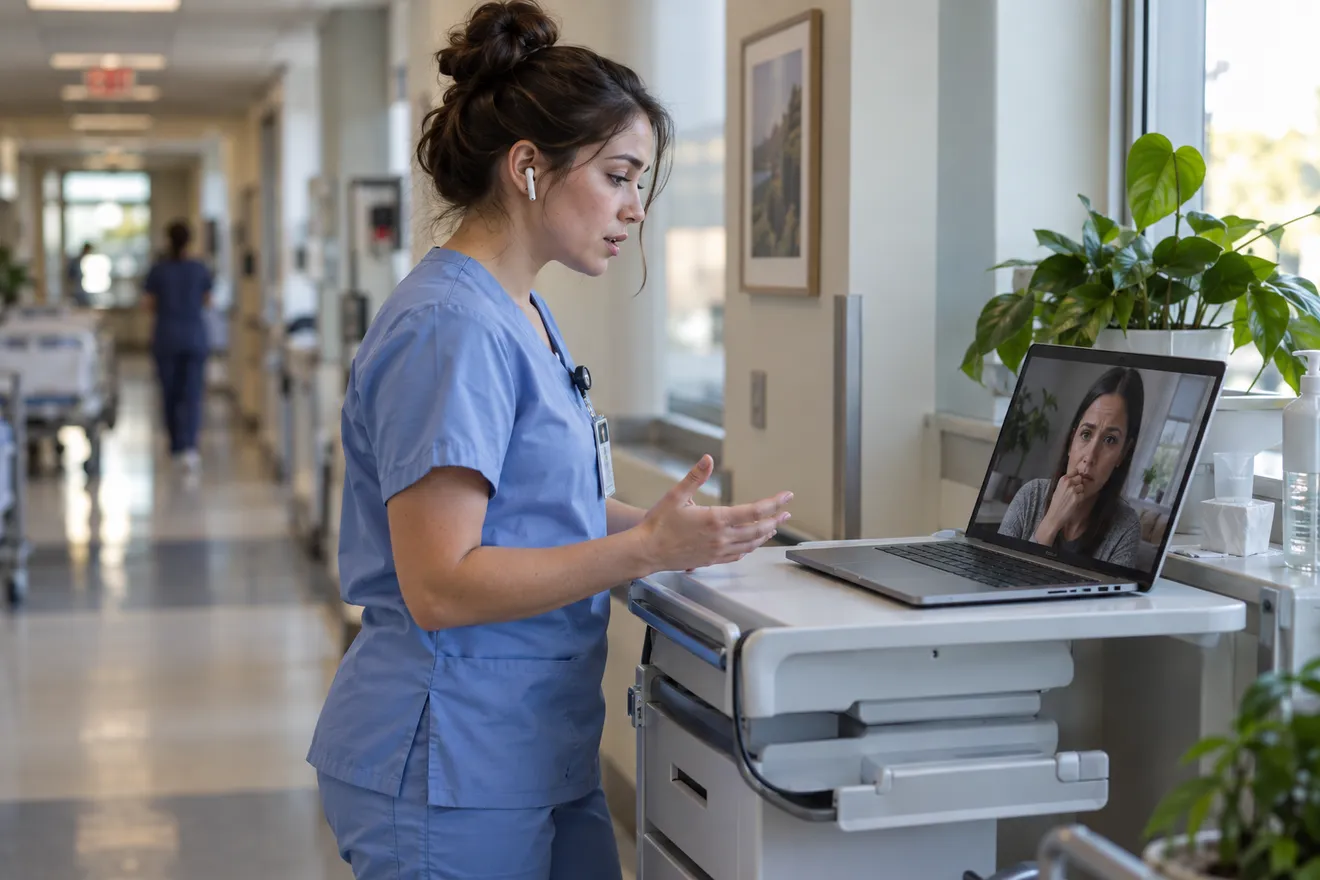
“Hi, this is Nurse Patricia Lowe. Tell me what changed with the resident.”
Report a change in a resident's condition

Nurses and nursing students talk out loud with a realistic AI avatar playing the patient or family. They practice bad news, handoffs, and the angry son at 3 a.m. Then they get a score on your checklist.
AI avatar · Senior livingNurse Patricia Lowe
Charge nurse
“Hi, this is Nurse Patricia Lowe. Tell me what changed with the resident.”
Report a change in a resident's condition
Scored on your checklist
Ready for the debrief
Nursing simulation is practice for patient care in a setting where mistakes are safe. Clinical simulation in nursing can use manikins, virtual reality, screen-based cases, actors, or AI. On Trainio, nursing simulation is spoken. Nurses and students talk with a realistic AI avatar, then get a score on your checklist and notes on their words.
Spoken, like the bedside. No menu of answers to pick from.
Safe to get wrong. Try again until it sounds right.
Ready for your debrief. Score, notes, and the full transcript.
Fidelity is how real the practice feels. Most programs mix all three.
Case studies, task trainers, roleplay with a classmate
Best for: First tries at a single skill
Screen-based virtual cases
Best for: Clinical reasoning
Computerized manikins, virtual reality, standardized patients
Best for: Full scenarios and graded exams
Spoken AI conversations fit next to all three. They add realistic patient and family talks without a sim lab. See how they compare in virtual patient simulation.
The talks around the care itself. They build on the therapeutic communication skills you already teach.
 Report a change in conditionWith Nurse Patricia Lowe, charge nurse
 Give a serious diagnosisWith Eleanor Griggs, patient, receiving a diagnosis
 Talk a family through goals of careWith Carol Whitman, patient's wife
 Calm a family who feels ignoredWith Daniel Brennan, resident's son
 Tell a family about a medication errorWith Colleen Marsh, daughter and health-care proxy of a resident
 Calm a combative patientWith Devon Carter, residential treatment client
Need a call to a provider at night, or your unit's discharge script? Build your own scenario
Nursing programs, and the hospitals that hire their graduates.


More on nurse onboarding and nursing competency assessment.
A score and notes on their own words, seconds after the talk. Educators see the same notes and the full transcript.

Daniel Brennan
Calm a family member who feels ignored
What went well
Try next time
“You're right, nobody called you back. I'm sorry. Here's what I know right now.”
Quoted from the nurse's practice
Pick a hard conversation, make it look and sound like your patients, send it to your staff, and see who's ready. No trainer to book, no classroom to fill.
Start with one of 1,000+ ready-made scenarios, or type what happened on your floor last week. In a minute or two you get a patient to talk to and a checklist of what good looks like.
Choose how hard the patient is, pick their face and voice, and set the rules the conversation has to follow. Then decide what a pass looks like for your team.
Assign it to the front desk, the night shift, or this month's new hires. Everyone gets a link and practices on their own time, on any shift.
Every practice is scored the same way, with a transcript. You see who's ready by person, team, and site, and you have something to show a surveyor.
Trainio is the AI roleplay training platform for healthcare teams.
 VideoVoiceTalking back
Faces and voices react to every word. Learners can switch to voice only.
Including the conversations nurses have every shift.
Write it from your competencies. Every nurse is scored the same way.
Attach a policy or script. Get a patient or provider to talk to.
Runs in a browser. A session takes 3 to 10 minutes.
The three types of simulation in nursing are low, moderate, and high fidelity. Fidelity means how real the practice feels. Low fidelity is a case study, a task trainer, or roleplay with a classmate. Moderate fidelity is a case on a screen. High fidelity is a lifelike manikin, virtual reality, or a trained actor. Most programs mix all three.
The main benefit of simulation in nursing education is safe practice. Students and nurses can face rare or risky moments without harming a patient. Everyone gets the same case and is scored the same way. Learners can repeat a case until it feels natural, and the debrief turns each try into a lesson.
Virtual simulation in nursing is patient practice on a screen instead of in a sim lab. In a virtual nursing simulation, students and nurses work through a case on a computer, tablet, or headset. Many are click-through cases with set answers. On Trainio, the learner talks out loud with a realistic AI avatar and gets a score.
Nursing simulation software, sometimes called a nursing simulator, lets people practice patient care on a computer instead of in a sim lab. Some run cases on a screen or in virtual reality. Trainio is the AI roleplay training platform for healthcare teams. With Trainio, nurses and students practice hard talks out loud with realistic AI avatars.
The best nursing simulation software depends on what you teach. Hands-on skills fit manikins and virtual reality. Clinical reasoning fits screen-based cases. For patient and family conversations, look for AI patients that talk back, a checklist you control, and transcripts for your debrief. Trainio is built for those conversations, with 1,000+ ready-made scenarios.
Nursing simulation scenarios often start with a sudden change in condition, a rapid response, safe medication use, or patient teaching. Many are talks, like bad news or goals of care. Others put the nurse with an angry family, a patient who refuses care, or a medication error to explain. Trainio has ready-made cases for each of these talks.
Open RN offers free virtual nursing simulations under an open license, including a therapeutic communication series. They're screen-based cases with set answers. To practice a spoken conversation for free, open a case on this page and talk to the AI patient for up to five minutes. Trainio also has a 14-day free trial. Source: Open RN Virtual Simulations.
Nurses can practice SBAR handoffs by building the call as a Trainio case. SBAR stands for situation, background, assessment, and recommendation. Paste your handoff script, and the AI avatar plays the provider or the oncoming nurse. Each part can be a line on the checklist. The library also has a ready-made case for reporting a change in condition.
Your state board of nursing decides how much simulation can replace clinical hours. In a national study by NCSBN, programs that swapped up to half of their clinical hours for good simulation saw similar results. Those programs all had at least 600 clinical hours. Each board sets its own limit, so check with yours before you count any simulation. Source: NCSBN National Simulation Study.
The INACSL Healthcare Simulation Standards of Best Practice call for clear objectives, a prebriefing, and a structured debrief. Each Trainio case comes with objectives and a checklist of what good sounds like. Learners get a score and notes after every try. The prebriefing and the debrief stay with your educators, with the transcript in hand. Source: INACSL Healthcare Simulation Standards of Best Practice.
Hospitals use nursing simulation training to get new nurses ready for hard talks before they face them alone. Residency and onboarding programs assign cases, like a change in condition or a worried family. Educators see each nurse's scores and transcripts, by person, team, and site. Refreshers fit between yearly skills checks.
Nurses and students talk to the AI patient out loud, like a real conversation. Most cases show a realistic AI avatar whose face reacts as the patient talks. The avatar hears the learner but never sees them, and the camera is never used. Learners can switch to voice only, and cases with children and teens are voice only.
A nursing simulation on Trainio takes three to ten minutes in a web browser. There's no sim lab to book and no headset to buy. Nurses can practice before a shift and students between classes. Every seat includes unlimited practice, so learners can repeat a case until it sounds right.
Trainio doesn't replace manikins, standardized patients, or clinical hours. It adds spoken practice for the conversations around care, between those sessions. Keep hands-on skills in the sim lab and graded exams with trained actors. Use Trainio for the extra reps on handoffs, bad news, and hard family talks.
Nursing simulation software costs depend on the type. Manikins and virtual reality need equipment, space, and staff to run them. Screen-based cases are often licensed per student. Trainio is priced per seat. The Team plan is $50 per seat per month, from 5 seats, with a 14-day free trial and no credit card.
Nursing simulation on Trainio uses made-up patients, so no real patient data is needed. Keep real names and records out of any case you build. Data is encrypted in transit and at rest on every plan. Signed HIPAA BAAs and one login (SSO) come with the Enterprise plan.
Decide how prepared your staff will be when it arrives.
14-day free trial · from 5 seats · no credit card